
I was tempted to call this post, and my upcoming class Braid Your Own Paracord! Paracord is a tubular braid around an inner core, and it’s quite possible to braid very similar-looking cords (with nicer colors and materials!) using loop braiding.
Two very different ways to braid a tubular braid around a core were described in the old English loop braiding manuscripts from the 15th and 17th centuries. I will be teaching both in my upcoming two-day class at Braids 2025 in June.
The 15th C. tubular braid method that could (optionally) be done around a core, involved the use of two loop exchanges, and was used with a wide variety of braids, from double-square braids, to the braids sometimes termed ‘Bends’ or ‘Chevrons’ in those manuscripts (twined braids, including Lace Vice below).
That tubular braiding method creates a round, firm braid even without using a core:

However, it can also be done around a supplemental, pre-made core, for a stronger and heftier braid – this was described in the 15th C. braid called Lace Double Covert. The pre-made core was itself a braided cord (“lace” in 15th C. English). However the core can also be something more solid, like tubing, or even a skewer or dowel.
A totally different method for braiding around a pre-existing core is hidden away in a single, obscure 17th C. manuscript (the Lansdowne Roll), where it has seemingly only been noticed and described by Joy Boutrup and Noémi Speiser, in the 4th volume of their series European Loop Braiding, Parts I-IV. They also managed to find three extant examples of this core braid! All three were on late 16th to early 17th C. purses, in various collections. With this method, each loop surrounds the core, rather than the braid itself being wrapped around the core. The two methods can be used with (some of) the same braids, but as you can imagine, they have very different results.
The 17th C. instructions and braids that Joy Boutup discovered (having this ‘new,’ previously unknown method for including a core) were all 10-loop hollow double braids. But I’ve found that the basic idea can be used with any tubular braid in the square braid family, including Spanish braids, and even the basic Square braid itself. The core can be anything from a length of rope or cord to flexible tubing, or even a solid object like a dowel.
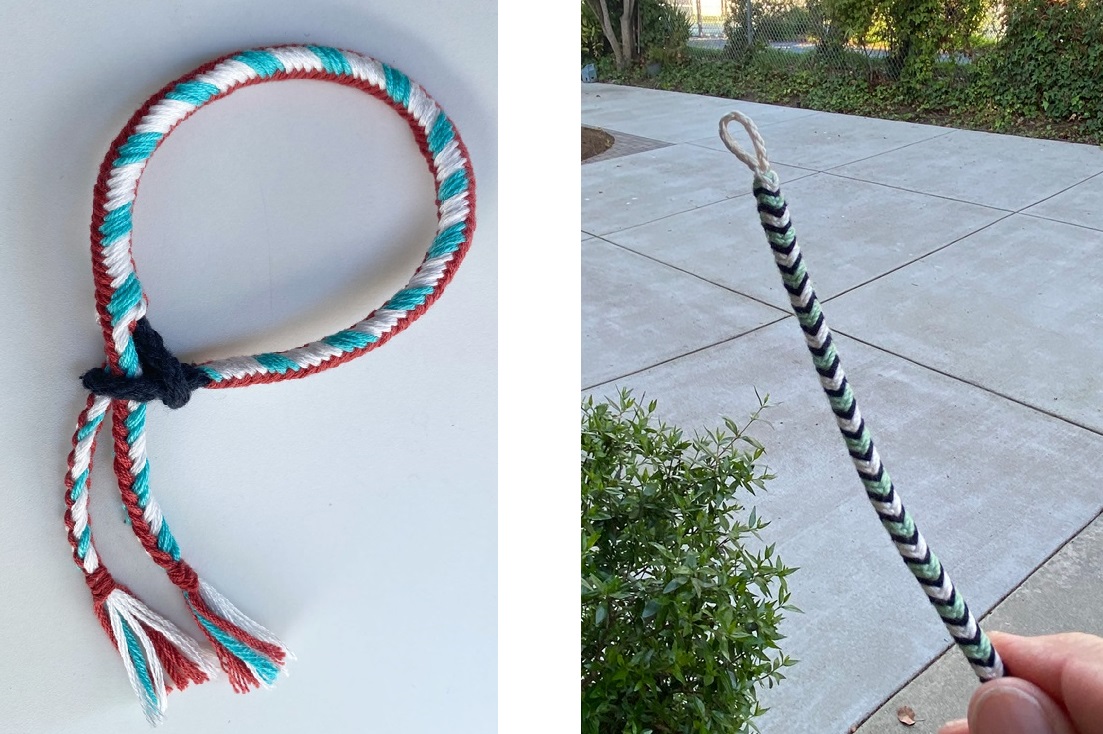

I plan to teach both a square braid and the (traditional) hollow double braid around a core, using this ‘secret’ 17th C. technique, with thanks to Joy Boutrup and Noémi Speiser for uncovering it!
Another class braid will be the 15th C. Couvert braid, which uses the 15th C. “two exchanges” tubular braid method. We will explore some of that braid’s very cool color-pattern possibilities, where the braider can switch at will between the color of the outer braid, and the color (or colors) of the inner, hidden braid:

I call the Couvert braid – and the others like it – “Double-tubular” because that’s what it is: one braided tube surrounding another braided tube. It basically makes its own core as you braid it! It can also be braided around a supplemental core, with almost no difference to the braiding moves, only to the set-up (the previously-mentioned Lace Double Covert). I will teach an option for an easier way to do the second loop exchange, as well as tips for the supplemental core set-up.
The braids below are plain weave double-tubular loop braids of many loops. The braiding moves are not traditional, but the double-tubular shape is made in the same way as similar, traditional 15th C. tubular braids were (by two loop exchanges). The patterning of the upper four braids alternates between two sets of colors. This is done by turning loops while braiding, just until the colors of the inner braid and those of the outer braid have switched positions. In 15th C. braids, this type of alternating pattern in a double-tubular braid was called compound, or coupen, cowpen, along with other spelling variations. (The term was not limited to double-tubular braid patterns, though – it probably implied one repeat of a color motif.)

4 braids with irregular “compound” (cowpen/ coupen) patterning.
The traditional Double-tubular braid is one of the many possible shapes a doubled square braid can take, depending on which if any loops are turned, and which loops are exchanged between the two braiders (some other double braid shapes that I teach on this site are hollow, flat, solid, side-slit).
I haven’t taught the double-tubular/ couvert braid here on my website, or at my previous class on double braids at Braids 2012, because – unlike the other double braid shapes – it normally doesn’t turn out well with fewer than 10 loops. (I primarily teach my solo-braider method for double braids, so I’ve focused on versions that can be done with 6 and 8 loops, rather than the traditional 10 or more loops that a cooperating pair of braiders would share.)
However, I have since found that you can make gorgeous 6- and 8-loop double-tubular braids, if you use flat papery yarn! (great for the full 10-loop version too). 6- and 8-loop double braids are not hard for a solo braider to learn, since they only require 3 or 4 loops on each hand.
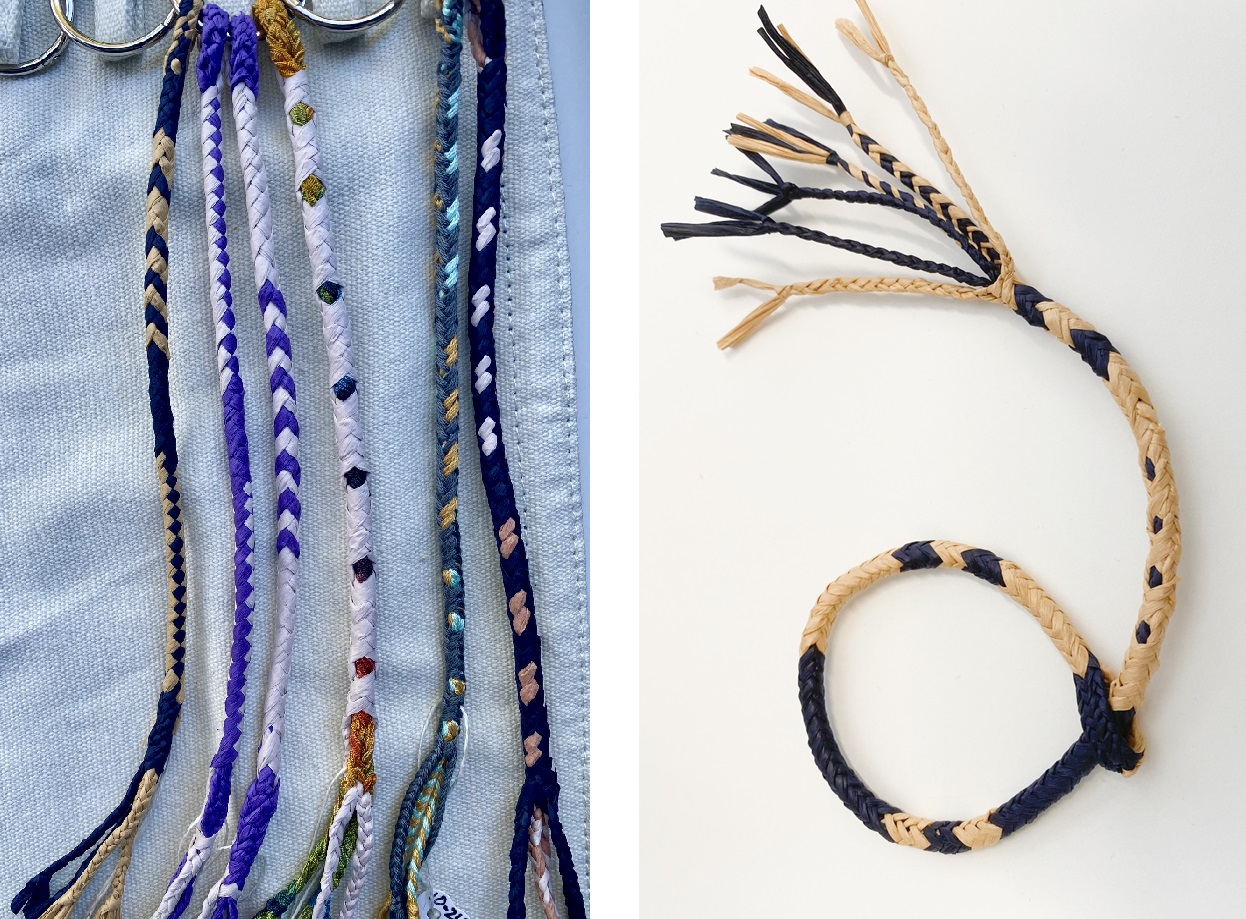
Viscose paper yarn (one braid also with variegated polyester ribbon yarn)
I will be teaching this wonderful braid both the traditional way, as a two-person braid, and (if time allows) with my solo-braider technique, using only 6 or 8 loops, and basically the same braiding moves as the other double braids in my Double Braid tutorials on this website. The double-tubular version just requires an extra loop-exchange between the two hands.
Notes:
- My sources for both information about, and the original wording of the 15th and 17th C. loop braiding manuscripts are:
Noémi Speiser and Joy Boutrup’s published (currently out-of-print) works
Cindy Myers’ / Silkewerk’s online pages: Fingerloop Braids – An ongoing comparison of fingerloop braids from three different manuscript sources
Lois Swales and Zoe Kuhn Williams’ site: Fingerloop Braiding:
Also Masako Kinoshita’s old L-MBRIC site, various issues, now archived. - I will not be teaching all the braids in images above. The class will be technique-based, covering two different techniques for loop braiding tubular braids: making various braids around a pre-made core, and with a self-core (the double-tubular braid). It will not be focused on producing finished objects.
- My class is not beginning level loop braiding, but there’s actually plenty of time between now and the conference to get past beginning level. You just need to be able to braid a basic 5-loop square braid fairly easily, using ring fingers (not index fingers) to transfer loops, the way I teach it in my “Start Here” tutorial. ‘Easily’ matters, because you don’t want to have to think much about the basic braiding moves once you add in dealing with a core, or with exchanging loops with a partner. But it is a quick braid to learn, and fun to practice! The more you already know, the more you can take away from the class, but that alone will be a great basis.
- Time permitting, I would love to meet with interested class members outside of class – including the three days prior to my class (my class is Thu and Fri) if you have any questions or would like a demo on a related or unrelated loop braiding topic. Any suggestions? Please let me know! There is usually time in the evenings (before or after dinner) to meet outside of classes, also on the field-trip day (Wednesday). Maybe starts or finishes, like something from my Longer Loop Braids post that doesn’t have a video? Or a particular braid that I don’t have a video for on this site (if so, let me know which one before the conference, so I can relearn it if necessary!)
Posted Feb 24, 2025
Last updated April 17, 2025
© 2025 Ingrid Crickmore


 Loop Braiding