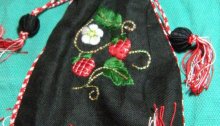
Readers’ Gallery part 2
Thanks, Gudrun, Julie, and Annie!
Historical information can also be found in the drop-down under “About” in the top menu.
Below are all my posts tagged “history”. The one with the most historical info about fingerloop braids is “Which Braids on this Site are Historically Accurate?”
“Kute Uchi” – Japanese braiding traditions. “Rodrick Owen and the Braids of the Mummies” – ancient Andean braiding traditions. In other posts, the historical information may not be the main topic. (Scan through post, and/or check footnotes at the bottom.)
Thanks, Gudrun, Julie, and Annie!
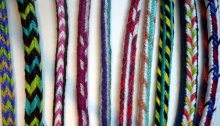
The Japanese hand-held loop braiding technique that preceded kumihimo and produced incredibly complex and gorgeous braids–some more complex than are even possible to make easily on braiding stands! Two videos teaching the two most basic moves for making square and flat braids, and text instructions for a more complex braid that requires using both moves.

An alternative method for braiding the 15th C. eight-loop braids known as Lace Dawns (or Daunce) and Lace Piole. It is a faster method, with no doubled loops on any fingers. (Requires using the thumb of only one hand, so might be a good intro to 9-loop square braids.)
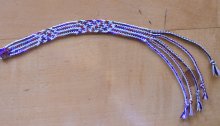
A ‘Plain Oblique Twined’ braid — usually abbreviated as POT by ply-split braiders. This kind of twining can also be done with loop braiding. I love this braid, and got to use it as part of a Braid Society Swap because of its unplanned resemblance to a Navajo sand painting figure… (not a tutorial)
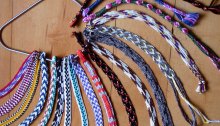
I am very excited about this! I just got word that my workshop proposal (Intro to double braids as a solo braider) was accepted by the organizers of Braids 2012! That’s an international braiding conference (who knew?) that will be held in Manchester, England next year, August 20 – 24, put on by the Braid…
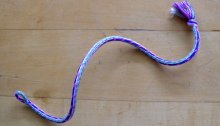
This is an incredible finger loop braid from the 14th Century! It’s only known from a single museum artifact somewhat older than the 15th C. loop braiding manuscripts. This braid is amazingly similar to a Japanese kute-uchi braid that was made by a completely different method…
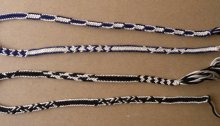
If you are already comfortable braiding 7-loop square braids, this seven-loop braid might be fun to try next. It has twice as many loop transfers as a square braid–and they are done differently than you might expect! (Includes set-up instructions for several different color patterns.)
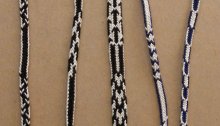
An intricate and unusual 7-loop braid —the word for braid was spelled some funny ways in the 17th C. manuscripts— is the basis of the 14-loop alphabet braid. Joy Boutrup described this 7-loop braid in her recent groundbreaking analysis of the 17th C. letter braids.
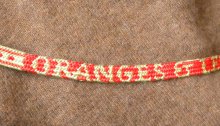
I’m almost finished madly braiding a letterbraid to send in to the Braid Society’s Traveling Exhibition*—still fiddling with the braidlets at the end. The orange is DMC cotton embroidery floss, doubled, so 12-strand, and the light green is an unknown brand of silk knitting yarn of similar weight (sport? or maybe thinner). The braid is…
 Loop Braiding