
Tutorial: 9-loop braids
Why waste two of our ten fingers? Use thumbs to make even bigger and better braids! This was done historically in (at least) China and Finland, as well as by my first loop braiding teacher here in the U.S.
Other terms for loop braiding are:
Fingerloop braiding, finger loop braiding, finger-held loop-manipulation braiding, Kute-uchi, Peruvian (or Andean) hand-held loop braiding.
Fingerloop braiding is done with loops held on separate fingers, hand-held loop braiding is done with loops held over the whole hand, lined up in order.
Almost all the posts on my site are actually about loop braiding, even the ones I haven’t placed in this category!
Why waste two of our ten fingers? Use thumbs to make even bigger and better braids! This was done historically in (at least) China and Finland, as well as by my first loop braiding teacher here in the U.S.
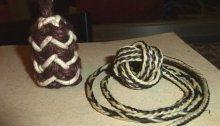
Update: Dominic Taylor will be teaching knotting at Braids 2016! His 2-day class is called Cylindrical Braids, which refers to nautical-type knotted ‘braids’ that can be formed around solid objects—like handles of tools, etc.
Here are photos sent in by a reader, Dominic, of some of his “bicolor loop magic” braids. Beautiful braids, and the knotting he’s done with them (and other cords) is fantastic!
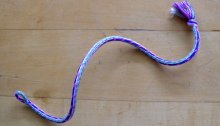
This is an incredible finger loop braid from the 14th Century! It’s only known from a single museum artifact somewhat older than the 15th C. loop braiding manuscripts. This braid is amazingly similar to a Japanese kute-uchi braid that was made by a completely different method…

Despite what you may have heard, when fingerloop braiding, you really can put your loops down and take breaks!
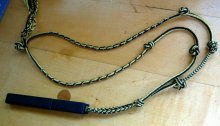
Bicolor loops are loops made out of two colors, tied or linked together. They can create very different braid patterns than the patterns you can get from single-color loops. Tutorial and tips for using bicolor loops, including 3 basic bicolor pattern variations that can be made with 5 or more loops, and how to switch between patterns within one braid…
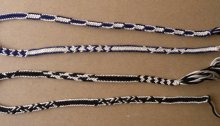
If you are already comfortable braiding 7-loop square braids, this seven-loop braid might be fun to try next. It has twice as many loop transfers as a square braid–and they are done differently than you might expect! (Includes set-up instructions for several different color patterns.)
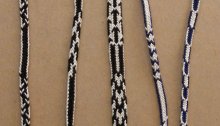
An intricate and unusual 7-loop braid —the word for braid was spelled some funny ways in the 17th C. manuscripts— is the basis of the 14-loop alphabet braid. Joy Boutrup described this 7-loop braid in her recent groundbreaking analysis of the 17th C. letter braids.
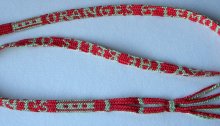
Ok, I finished the last bit, and decided to take a couple more pics after washing it and before sending it off. After shrinking less than an inch, it’s 46 inches total–40 inches to the point where it splits into 2 separate parts for the first half of the “tail.” A little over 1/2 inch…
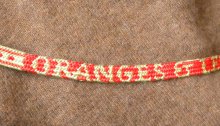
I’m almost finished madly braiding a letterbraid to send in to the Braid Society’s Traveling Exhibition*—still fiddling with the braidlets at the end. The orange is DMC cotton embroidery floss, doubled, so 12-strand, and the light green is an unknown brand of silk knitting yarn of similar weight (sport? or maybe thinner). The braid is…
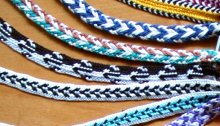
Loop braiding is a fun, fast way to make strong, beautiful cords and bands. Click on Tutorials in my upper menu to find all my tutorial posts, in an ordered sequence. Please comment under any of the posts! Thanks for visiting Loop Braiding!
 Loop Braiding