Worldwide, the most common loop braids seem to have been simple, 2-pass braids of 5 loops. There are 3 different traditional fingerloop braiding methods for making these braids: the A-fell and V-fell methods (both done with palms generally facing each other), and a third method called Slentre (done with palms facing downward). Masako Kinoshita called them Method 1, 2 and 3. Noémi Speiser came up with the terms “A-fell” and “V-fell” in her books on loop braiding. I don’t know where the term “Slentre” came from. Most sites that teach fingerloop braiding don’t use those terms, they would just call any of them fingerloop braiding. Any of these three methods can be used to make the same basic 3-to-7-loop braids. However, it’s doubtful whether Slentre (palms-down) braiding can be used to make the more complex braids that are possible with palms-facing methods like A-fell and V-fell.
Update: At the recent Braids 2025 conference, Joy Boutrup (foremost researcher of historic European loop braids) told me that in all her extensive research – ongoing for over 20 years – she has found no reliable evidence for Slentre, the “palms-down” method of loop braiding, ever having existed until modern times, either in the Faroe Islands or elsewhere. She suspects on the basis of her review of published sources, that a particular Danish textile researcher (I don’t remember his name) in the 20th C. misinterpreted some minimal information he had received about how a braid was made, and came up with the palms-down fingerloop braiding method himself. Since then it has become widely taught and disseminated. It’s even currently taught to most children in Denmark as a school subject. Joy thinks that Slentre probably IS an easier method to teach and learn for making the most basic braids, although it can’t be easily used to make the many variations possible with palms-facing methods.
The V-fell method I teach is known from Asia and the Pacific, including India, China, SE Asia, Indonesia, Japan, Finland, and part of Russia. The A-fell method is known from Europe, the Middle East, and Africa. In South America and Finland, both these methods have been documented. The Slentre method was not originally very widespread – it’s claimed by some to have been a traditional practice in the Faroe Islands and possibly Denmark (like Greenland, the Faroe Islands are constitutionally part of Denmark).
The A and V-fell methods are simply opposite versions of each other. Either method can be used to undo a braid made by the other method. In both methods, palms generally face each other, and a loop travels between the lowest finger of one hand and the highest finger of the other hand, through the intervening loops. With A-fell braiding, the index finger reaches through its neighboring loops (on the same hand) to fetch the the other hand’s lowest loop. With V-fell braiding, the ring or little finger reaches through the other hand’s loops to fetch the other hand’s index finger loop.
V-fell method diagram, braiding method taught here
The A-fell method can be seen in this Fingerloop Braiding website’s intro video: https://youtu.be/0UG4CZkZFdM?si=47rgMp5SBxrJ5QQ6&t=107 (link opens video at 1:47 min, where actual braiding moves are demoed)
Slentre loop braiding is done with the palms facing down, i.e. facing the floor for all the braiding moves. The index finger is the active braiding finger, and it reaches through the loops of the opposite hand — through (or over) the opposite hand’s index loop first, then through the middle finger loop – to fetch the opposite hand’s furthest loop. Here’s a link to Morgan Donner’s Youtube tutorial for the Slentre method: https://youtu.be/GQpEcGfv-rY?si=_aM5sdhB09mvFfaZ&t=241
The link opens the video at 4:01 min, where she starts braiding a 5-loop square braid (she puts her operator finger through both of the first two loops of the opposite hand before taking the third loop).
I think the only historically documented Slentre braid is like the ‘broad lace’ in the 15th C. loop braiding manuscripts, in which the operator finger passes over the first loop (skips it) and only goes through the second one. (Although now I’m not sure whether there really are any historically documented Slentre braids – see my update from Joy Boutrup above.)
For basic loop braids (square braids and their flat variation; and triangle and D-shaped braids), I teach the V-fell method – method 2. I learned this method here in the U.S. (California) in 2006 from a young woman who had learned it as a teen in summer camp on the west coast. She called it braiding, and used it to make square braids of 5 to 9 loops, using thumbs as well as fingers when braiding 9-loop braids. I have since met or heard from several others who learned this V-fell loop braiding method before my blog tutorials came out – informally from friends or at summer camp – including Zoe Kuhn Williams of the Fingerloop Braiding website (which teaches the A-fell method)! https://fingerloop.org/.
When I started this blog (toward the end of 2010), only the A-fell method seemed to be known and taught anywhere. I couldn’t find the V-fell method in any published or online sources, with the exception of a brief and technical description on Masako Kinoshita online journal L-MBRIC (Loop-Manipulation Braiding Research and Information Center (https://web.archive.org/web/20160430114718/http://www.lmbric.net/IL/IL.html ). I didn’t know about Noemi Speiser’s books, which mention the V-fell method, but don’t teach it.
At that time, most on-line references and how-to’s for fingerloop braiding taught the A-fell method. This was a result of a fairly recent revival of interest in loop braiding in the U.S and Europe. The method and practice had gone completely or near-extinct in Europe after the advent of industrial braiding machines around the beginning of the 1900’s, but amazingly, it was re-discovered and relearned in the late 1900’s from a few 15th and 17th C English manuscripts languishing in museums and private collections.*²
Interestingly, despite its originally very limited distribution, the Slentre method had been taught fairly widely in textile and craft circles in the U.S. since the 1970’s, and apparently in Europe as well, though it wasn’t referenced much online when I was first searching. It was first introduced into the U.S. by Jackie Wollenberg, a weaver and teacher, who had learned it while living in Denmark.*³
Why I prefer the V-fell method:
To me, the V-fell method has a significant advantage over the other two methods: it allows using thumbs as well as fingers to hold loops, so it can be used to make braids of up to 9 loops (18 separate braiding strands) without the braider having to carry more than one loop per finger. Both other methods limit a braider to 7 loops (14 separate strands) before some finger or other has to double up and carry more than one loop. (The Slentre method has further limitations, see footnote *5.) And once I did start adding more than one loop onto certain fingers, I found that the V-fell method could be used to make braids of up to 13 loops rather easily, whereas 8 loops seems to be a limit for A-fell braiding (the historic European braids called Dawns or Daunc, and Piole)
The A and V-fell methods are highly complementary, as each method can undo the other’s 3- to 9-loop braids. This may not sound helpful, but it is very handy for correcting mistakes!
Note: There are also many other fingerloop braiding methods besides A-fell, V-fell, and Slentre – for making more complex braids, or different types of simple braids. For example, loop-exchange methods as for the traditional spiral braid (‘lace bend round’) and several other braids; the traditional methods for the so-called “spanish” braids; twined braids (often called “bends” or “chevrons” in the old loop braiding manuscripts); the “hollow lace of VII” family of braids; my double braids made by a solo braider, etc. None of these are made with the braiding movements known as “A-fell” or “V-fell”. And be aware that the terms A-fell and V-fell originally and primarily simply refer to the shape of a braid’s lower, working edge, even if it is not a loop braid at all! Noemi Speiser borrowed these terms to use them for these two opposing fingerloop braiding methods – they are also used in contexts that have nothing to do with loop braiding.
Hand-held loop braiding
This is another form of loop braiding, in which loops are held around the whole hand rather than on individual fingers. It is much less common than finger-held loop braiding – known or inferred from the past only in Japan, Peru, and Oman.
(I have a how-to for two Japanese hand-held loop braids, along with links to more information, in a post called Kute-Uchi, and more about ancient Peruvian loop braiding in Rodrick Owen and the Braids of the Mummies, which includes photos of hand-held loop braiding with a braid of over 60 loops near the bottom of the page.)
In areas where hand-held loop braiding was practiced, it most probably never replaced fingerloop braiding for simple braids of fewer than 8 to 10 loops. My Kute-uchi tutorial introduces the technique with a 5-loop square braid just as an easier introduction to hand-held loops, but according to Masako Kinoshita, Japanese braiders in the past would have used finger-held loops for this braid. For braids of fewer loops, finger-held loops have definite advantages over hand-held loops: the individual loops are easier to keep track of, braiding moves can be more automatic, and loops of slightly different lengths are easier to tension evenly, since fingers can adjust independently to hold loops of slightly different lengths at the same tension.
Hand-held loop braiding becomes more efficient for braids of more loops than can be managed on fingers (and according to Noémi Speiser, for some twined braids). And hand-held loops are required for making four-layer loop braids, like some Japanese and Omani braids. Some solo-braider Kute-uchi (hand-held loops) braids made on four layers are identical in structure to equivalent two-braider finger-held loop braids made on two layers (the double-square aka rectangular braid for example), others like the Kute-uchi “four-flat-braids-made-simultaneously,” can only be made with hand-held loops, not fingerloops. And because the Kute-Uchi version of the rectangular (double-square) braid is produced on-edge, ie with its rectangular cross-section on the vertical rather than horizontal axis, it allows two or more side-by-side braiders to co-operate in braiding two or more of these together into massively intricate and beautiful “quadruple” or “sextuple” square braids, such as the historic Chuson-ji braid and others. These braids are not possible with fingerloop braiding techniques, no matter how many braiders co-operate.
Team loop braiding/ multi-braider loop braiding
With either fingerloop braiding or hand-held loop braiding, two or more braiders can join together in making a single braid of many more loops than one braider can manage alone. This practice was probably very widespread historically. It is known from several areas of the world, including Europe, Japan, Asia (and probably in South America as well). This might sound very complicated, but two people who have each just learned how to braid a 5-loop fingerloop braid can then easily learn how to braid a combined 10-loop “double-wide” braid working together (demonstrated by two new braiders in my tutorial Braid a Ten-loop Braid with a Friend).
Stand-and-Bobbin braiding (kumihimo and other similar traditions)
This is another braiding method. Various types of raised stands have been used around the world, with threads or yarn wound onto bobbins and hanging down over the edge(s) of the braiding stand.
This type of braiding may seem unrelated to loop braiding, but Masako Kinoshita’s painstaking research in the 1980s and 90’s found that in Japan, loop braiding preceded stand-and-bobbin braiding by a thousand years, and only began to be replaced by stand-and-bobbin methods in the 1700’s. (Japanese stand-and-bobbin braiding is usually referred to by the Japanese word kumihimo.)
By analyzing old manuscripts and braids, she discovered that all the complex and magnificent older royal, samurai, and temple national treasure braids had actually been made with loop braiding–the larger ones with many braiders cooperating and using hand-held loops. This came as a big shock to the Japanese kumihimo community of the time, because loop braiding had been entirely forgotten by then, and it was assumed that stands and bobbins had been used since time immemorial.
This shift from hand or finger-held loop braiding to using braiding stands and bobbins may have also occurred in other parts of the world where stand-and-bobbin braiding methods are used. There appears to be evidence that loop braiding goes back thousands of years (see footnote 10 on Mari Omura’s research on ancient Chinese braids).
In an article in Strands, Rodrick Owen noted that Lao Mien braiders practice both fingerloop braiding and stand-and-bobbin braiding (I gather from the article that the Lao Mien are a southern Chinese minority group?). Two Lao Mien braiders in California showed Rodrick Owen how they used stand-and-bobbin braiding to make longer lengths, but preferred loop braiding when making shorter lengths of the same braid, as it was a quicker method.*6
Stand-and-bobbin braiding is known from many parts of the world, including mainland Asia, Japan, Scandinavia, and the Middle East, and is suggested by archeological artifacts from ancient Greece and elsewhere (cf Elizabeth Wayland Barber in The Mummies of Urumchi *7 ).
Braiding from a slotted card
This has been done for other types of braids even before it came to be used in Kumihimo. Rodrick Owen first came across this method in the late 70’s in a craft book by Lynn Paulin called Weaving on Rings and Hoops, in which Paulin suggests using a slotted card for braiding a 16-strand African braid. Rodrick then applied this idea to the Andean sling braids he was teaching at the time (this was before he had encountered Kumihimo). *9
When he visited Japan to learn Kumihimo braiding from Makiko Tada, he showed her the slotted card method, and Makiko Tada subsequently began to teach it with some Kumihimo braids as well, as a cheaper and more portable method than a wooden braiding stand. A slotted card has been used within the Braid Society in the U.K. to teach a braid they call the “Fill the Gap” braid – a braid they teach widely as a first introduction to braiding. I don’t know the history of that “fill-gap” braid, but Rodrick Owen was one of the founding members of the Braid Society, and I would guess that many of the other members were aware of his slotted-card method.
The braiding process with a slotted card is very different from the equivalent process on a braiding stand, even if the resulting braid has the same structure. On a braiding table, the braider typically uses both hands simultaneously to move 2 strands on opposite sides of the table. With a slotted card, the braider can only use one hand to move strands, because the other hand is holding the card. Threads are ‘popped’ into and out of slots, rather than hanging freely with weights on the ends, which can make it more difficult to tension evenly. The card method is usually slower than braiding on a braiding stand. On the other hand, a card is much more portable than a braiding stand, and can be used almost anywhere – in a plane, car, bus etc. I tend to get repetitive stress pain in my card-holding wrist – this may be a personal defect, but there is certainly a more limited and one-sided range of motion in braiding from a slotted card compared to the graceful moves of a skilled braider working on a braiding table!
If not cited below, the sources for most of my information about loop braiding are Noémi Speiser’s book Old English Pattern Books for Loop Braiding, Masako Kinoshita’s site on loop braiding worldwide: Loop-Manipulation Braiding Research and Information Center News (see my Guide to L-MBRIC), and personal observation and experience.
There’s more about the three parallel fingerloop braiding methods, along with how I happened to get interested in loop braiding, in the “Notes” section following my 9-loop square braid tutorial…
More on Slentre braiding can be found in footnote *5 below.
Info pages (these can also be accessed through the “About” tab in my upper menu):
Page 1: About Loop Braiding
Page 2: About Me
Page 3: Contact form
Page 4: A-fell, V-fell, Slentre, and hand-held loop braiding
Page 5: Too-Many-Loop Braids
Page 6: Unorthodox Braids
Page 7: Old English Pattern Books for Loop Braiding
Page 9: Alphabet braids of the 17th Century
Page 10: Terminology
Page 11: Guide to L-MBRIC (Masako Kinoshita’s Loop-Manipulation Braiding Research and Information Center News site)
Page 12: Braids in my header photo
Page 13: Mystery of the ‘Broad Lace’s sisters
Index to tutorials
Index to posts
Notes:
*² Since the 1990’s these manuscripts have been extensively researched, analyzed, and decoded by Noémi Speiser and Joy Boutrup. Lois Swales and Zoe Kuhn Williams have also researched and translated many of these manuscripts and their online site (fingerloop.org) has directions for the A-fell method, along with many historic braid patterns.
*³ The 5-loop Slentre braiding method was taught in guild and fiber convention workshops across the U.S. for about 10 years by Jacqueline Wollenberg, from the 70’s into the early ’80’s. Jackie learned the technique while living abroad in Denmark. (by personal communication with Jacqueline Wollenberg)
In 1978 Slentre was described in Shuttle Spindle & Dyepot by Susan Scott Bernal, who had learned the technique from Jackie Wollenberg (Shuttle Spindle & Dyepot Spring 1978 Issue 34). In the 90’s Slentre was described by Anne Dyer in her book Purse Strings Unraveled.
Slentre may have originally been limited to the Faroe Islands, which are far from, but politically linked to Denmark. U.S. textile artist Jackie Wollenberg learned a Slentre braid while living in Denmark in the 1960’s or 70’s, which she subsequently taught widely here in the USA at weaving guilds and conferences throughout the 70’s and 80’s. A student of hers, Susan Scott Bernal, published the method in the 1978 issue of Shuttle, Spindle and Dyepot, a fiber arts periodical. Bernal called the basic Slentre braid a “half-round braid.” I met Jackie Wollenberg in 2007 or 2008 when she hosted one of Rodrick Owen’s braiding workshops, and she still had piles of Slentre braids in her studio, in many different colors and fiber types.
*4. The V-fell method is briefly described in Noémi Speiser’s books on braiding, and in Masako Kinoshita’s online journal L-MBRIC, in the introduction to its illustrated instruction series. (Kinoshita refers to the V-fell method as “Method 2″). By “not taught” I mean that up to when I started this blog, there were no how-to’s or step-by-step instructions published in print or on-line teaching this method.
For references to current practice of traditional loop braiding, see my guide to Masako Kinoshita’s old site L-MBRIC (Loop-Manipulation Braiding Research and Information Center News): Guide to L-MBRIC.
L-MBRIC was a semi-yearly journal published in English and Japanese, with a multitude of articles on the world-wide history and current practice of loop braiding, many containing information impossible to find anywhere else.
*5. Slentre Braiding:
Note: Slentre can be also used to make square braids and flat braids like those of the other two methods: here on Dietlind Wagner’s site she shows how to make a 5-loop square braid using the Slentre palms-down method (the transferring loop passes through two loops, skipping over none).
Slentre (palms-down fingerloop braiding) is taught fairly widely both online and in some published sources, but I’ve never come across any comparisons of Slentre to other methods for making fingerloop braids. From the little that’s written about it, one might easily assume that braiding “palms-down” and braiding “palms-facing” could produce equally complex loop braids. In my experience this is not the case. Slentre braiding is very interesting historically, and works fine for making a few basic loop braids, but in general is a much more limited method than either of the two palms-facing methods.
Slentre fingerloop braiding works just as well as palms-facing methods for making square and unorthodox (“semi-flat”) braids of 7 or fewer loops and only 2 braiding moves (“2-pass” braids that have only one braiding move with the left loops, and only one braiding move with the right loops). It is much less convenient for making the truly flat, or the completely divided variations of the square braid – they are doable, but the “no turn” loop transfer is more awkward than with the palm-facing methods. So far, I haven’t actually even seen a flat, single-layer Slentre braid taught anywhere, or the divided version for braiding a opening into a braid, though I have made both myself just to prove that they are possible with Slentre. (You have to do a rather convoluted turning maneuver with the transferring loop to get it to come over to the other hand without a twist in the loop – necessary for both those variations.)
However, beyond the simple, two-pass braids like square braids that can be made with A-fell, V-fell, or Slentre braiding, there are other types of loop braids that can be made with palms facing each other, but not (as far as I know) with the loops held palms-down. For example, braids that require more than two loop transfers in each cycle of moves – sometimes two transfers in opposing directions on the loops of each hand (like the braids called “Spanish” in the 17th C. English loop braiding manuscripts), or 4 “exchange” transfers between the two hands (spiral braids, lace maskell, etc). Also, braids that require carrying extra loops on one or more fingers. I doubt any of these would be possible or easy to do using the palms-down hand position. I also suspect it would not be as as convenient for two or more palms-down Slentre braiders to co-operate in braiding one much larger braid, as was done traditionally with both “palms facing” braiding methods, and with a wide variety of resulting braid forms depending on whether loops were transferred with or without a turn/twist.
If someone can succeed in using a palms-down method for making “exchange” braids like the Spiral Braids and Lace Maskell (photos on Cindy Meyers’ Silkwerk site); or so-called Spanish 4-transfer braids; or the hollow lace of 7 bowes (on Silkwerk), in which two of the fingers on one hand carry two loops each; or the Grene dorge a.k.a. Barleycorn braid, (described on Silkwerk and on Youtube in text and video) in which 2 fingers carry loops that twine between the square-braided loops of the other 4 fingers; or in braiding complex braids as a two (my site) or three-person team (photo on an SCA site opens in another tab); or in braiding these multiple-worker braids as a solo braider, please let me know and I will stand corrected!
I stand corrected on one of these! Specifically, on two (and therefore more) braiders team braiding with loops held palms-down!! See Kim and Carol’s video (the horizontal video) in my recent Iron Age loop braid post.
I don’t mean to imply that it’s a bad thing to ever turn one or both palms down while braiding. There is nothing wrong with any comfortable hand position when braiding if it works well to accomplish a particular loop movement. But I do feel that if you learn the most basic braids “palms down” (Slentre) and don’t move on to learning the “palms-facing” methods, it will limit your range of loop braiding possibilities quite a bit.
Update Oct 2015: Gary Mitchell (of the FingerTips loop-braid interactive pattern-planners) just showed me some interesting sturctures and color patterns he came across that were made with Slentre braiding (see note below this one – it turns out that palms-up methods can also produce these color patterns and structures) These are bicolor loop patterns in which the two strands of a loop are braided as one single braiding element – the two strands of each loop stay together throughout the braid, because loops are only drawn over and under the other loops, never through any of them. (This is not a standard Slentre braid, btw).
The resulting braided structure is much simpler than those in which a loop functions as two separate elements, but with bicolor loops it can result in some interesting 2-color patterns that are not possible when loops are taken through other loops as in most loop braids. Gary came across this type of braid in a how-to book on how-to book on Slentre fingerloop braiding by Dietlind Wagner (in German – still available, but a newly revised and improved edition will be available soon, according to the author). Gary has since has developed several pattern variations of this type of braid. On Gary’s FingerTips site, click on Slentre Braids from Germany, described by Dietlind Wagner to see some of the patterns he has come up with, based on her examples.
For these color patterns, the two colors of each loop must stay in the same left-right order throughout the braiding procedure. This seems to be helped by the palms-down hand position, because all the loops are held in one flat horizontal plane, with the two shanks of each loop held in a same left-right orientation rather than an “upper-lower” orientation.
Update Sep 2019: Well, it seems we were wrong that those two-color braid patterns can only be made with palms-down braiding. I have to work on this some more, but braiding them palms-up / palms-facing may simply require transferring loops “from below” (as if to turn the loop – however with this type of over-under-whole-loop braiding, amazingly the loop will not actually be turned!) I discovered this while writing up my recent Iron-age Braid post… The little black and white braided section of the ending loop below has the same type of pattern as Gary Mitchell’s pattern-variations of Dietlind Wagner’s braids, yet I braided it palms-up or facing each other (that black and white section was made with 4 black and white bicolor loops):
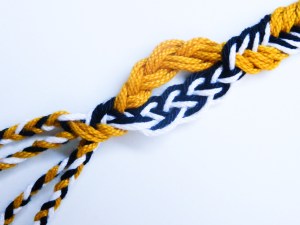
Loop at bottom of a Lace Broad Party, made with 4 bicolor black and white loops, and 3 gold loops.
Gary’s site shows several more patterns like this, although more intricate (more than only 4 loops, and in various dark-light configurations). You can see in example above that the black strand is always nested just to the left of a white strand, and it is this regularity that creates the overall dark-light design. If you start braiding with some of the loops in the opposite left-right color-order, or perhaps with some solid white or solid black loops, very different dark-light patterns result.
*6. “Interlaced Braids, An Overview,” by Rodrick Owen, published in Strands [annual journal of the Braid Society], Issue 13, 2006. Article is on pp 11-26, his account of the Lao Mien braiders is on page 20.
*7. In The Mummies of Urumchi, Elizabeth Wayland Barber mentions some of the intricate braids that were part of the textiles found with these mummies – some braids were even sewn together lengthwise to make wide expanses of fabric, even though there were also plenty of woven fabrics present as well – and relates the braids to stand-and-bobbin techniques. One of her braid descriptions sounds to me just like a description of a typical two layer twill loop braid (like the ones I call square, double, and Spanish braids, see my Terminology page). Other descriptions may be of twined braids (in the old English loop braiding manuscripts, the braids made by twining are often called “bends” or “chevrons”).
Barber describes finding out about kumihimo stand-and-bobbin braiding later on, after seeing the Urumchi braids, but she doesn’t mention loop braiding, so I assume she wasn’t aware of it at the time she wrote the book — or perhaps wasn’t aware that it could be used to make such complex braids. She mentions in passing that, while in ancient (Greek?) archaeological sites braiding bobbins are found but not the braids, here in the Urumchi sites (areas now part of China, north of India), the braids are found without any bobbins. I can’t help suspecting that the Urumchi braids were made with loop braiding rather than stands and bobbins. For one thing because loop braiding seems to have had a near-worldwide distribution, with indications that it tends to precede stand-and-bobbin braiding, and also because it is much easier for textiles to decay – narrow ones especially – than bobbins of almost any material. Of course that is not proof in itself – bobbins may not have been buried as grave goods, for example, if grave goods were the only artifacts found from that culture.
*8. The fell is the bottom edge of an in-progress weaving or braid–the “growing” edge. Because braids are made on the diagonal, in-progress braids have variously-shaped diagonal fells (as opposed to weavings, which usually have a straight, horizontal fell).
The two loop braiding methods called “A-fell” and “V-fell” were named by Noemi Speiser for their fell-shapes, or rather, for the opposite and distinctively different directions of their braiding movements.
Any braid in which the outer strands are continually brought/braided toward the center of the braid will have a lower “growing” edge shaped like a V. Click link to see an example of a V-shaped fell at the bottom of an in-progress braid being made on a takadai – a type of Japanese braiding stand. (photo will open in a new tab). In a typical fingerloop braid, the fell itself isn’t usually very discernible – it’s obscured by the many strands of loops stretching over the fell down to the fingers. However, in both the Slentre and the so-called V-fell loop braiding methods, outer loops are drawn toward the center of the braid with each braiding motion.
A braid in which the center/innermost strands are continually braided toward the outer edges of the braid will have a fell shaped like an upside-down V – sometimes called an A-shaped fell. This is the direction of the braiding movements for square and unorthodox braids as they have commonly been made in Europe and elsewhere, which is why Noemi Speiser used the term A-fell for that method. (Masako Kinoshita calls it Method 1.)
The shape/ contour of the fell reflects the order and direction of the braiding moves. It doesn’t necessarily reflect or reveal the over-under structure of the braided fabric, however.
A wide braided textile could be made with any one of several variously zig-zag-shaped fells, or an A or V shaped fell, or one long diagonal, yet have the exact same “weave” structure to the finished fabric (say plain weave, twill, etc). There would be no way to tell what the shape of the fell had been during the process of braiding if: 1. the braid were turned so the bottom was at the top, or 2. if the lower edge were hemmed, or 3. if the braider stopped braiding partway through the last row rather than finishing it, or 3. finished the braid by braiding in sections in order to “catch up” the unbraided areas in the middle, or at the two sides (thereby forming a zig-zagged / roughly horizontal lower border).
*9. “My Never-ending Story with Braids,” Interview of Rodrick Owen by Ingrid Crickmore in Strands, issue 24, 2017 (annual journal of The Braid Society)
*10. Mari Omura, “Archaic Braiding Techniques” in Threads that Move, proceedings of the international Braids 2012 conference (shown near the top of my sidebar). Most of Mari Omura’s historical and archeological research on loop braiding in Asia is published in Japanese, in Japan. Some of it is translated in the Proceedings books from the first two international BRAIDS conferences: Space, Time and Braid (2007), and Threads That Move (2012). Check with the Braid Society in England, and Braiders Hand in the U.S. for copies. Note – the first of these is not shown in my sidebar, btw – the two I show there are from the 2nd and 3rd conferences, not the first one.
I can’t find many English references online to her work outside of Masako Kinoshita’s old L-MBRIC newsletter. [newly-working links to all L-MBRIC issues are listed here on my index to L-MBIC, where I summarize the topics in each issue.] Omura has done extensive research on Japanese, Korean, and Chinese loop braiding history, including collaborating with archeological teams investigating things like rust-tracings of braids on ancient armor (!). Here is a link to information about one of her studies (through the Gangoji Institute for Research of Cultural Property, Japan):
(English title) Basic study of the appearance and transmission of braiding techniques in ancient Asia, 2015
(In Japanese) 古代アジアにおける組紐製作技法の発生と伝播に関する基礎調査
Study citation info
L-MBRIC issue 10 includes a report by Masako Kinoshita on some of Omura’s research examining “Xi” – probable loop-braided fabrics from the “Warring Period” (402 B.C. – 221 B.C.) tombs in Hupei province, China. Some of the Xi braids discovered had been braided with pick-up patterned Chinese characters for “Thousand Gold” ie Chinese letter-braids!
L-MBRIC issue 11 has another article (by Mari Omura), on this topic, showing photos of her reconstruction of the pick-up patterning method of Xi braiding, and noting an even older literary quotation in a classical Chinese poem: “…handling reins like braiding” that seems to be a reference to loop braiding.
*11. There is evidence of loop braiding from one or more centuries B.C. in Asia: a Chinese 1st C. BC Bronze of several textile workers includes a pair of loop braiders cooperating to make a long braid (See L-MBRIC issue 3 via my LMBRIC guide); also research into even earlier periods by Mari Omura, see note 10 above. European loop braid artifacts from as far back as 900 AD are cited in European Loop Braiding: Investigations and Results–Parts I, II, III, IV, by Noémi Speiser and Joy Boutrup, published and edited by Jennie Parry, 2009-2011. Many of those earliest braids are quite complex, made by multiple braiders working together. Narrow textiles like braids don’t survive in most European archeological sites much longer than a few hundred years, but a study of two Iron Age braid fragments recovered from the Hallstatt Salt Mines in Austria found that they were probably loop braided (circa 500 BC, so 2,500 years ago). A well-preserved bronze-age square braid fragment that may have been loop braided was found in an archeological study of an ancient Egyptian copper mine located in present-day Israel. (See L-MBRIC issue 7 via my LMBRIC guide) These artifacts were preserved in very unusual and extreme conditions.
[Update: see my more recent historical post for more details.]
Posted Dec 2, 2011
Last updated Feb 15, 2026
© 2011–2026 Ingrid Crickmore
Content of this website may not be posted or “reposted” online, sold, or used in fee-based workshops without my permission. It may be shared off-line with certain restrictions.
See full copyright restrictions and permissions at the bottom of the sidebar (if you are on a small screen, the ‘sidebar’ may appear somewhere other than at the side). ..

 Loop Braiding
