
finished Citrus Letterbraid Bell-pull. (click 2 times to see the braid structure)
The loops had been about 77″ before braiding, but I ended up cutting off almost 12 inches of unused loop below the knots after I was done. So I could have gotten away with a 68″ warp, allowing for a few inches of finger-ease at the end of the loops.

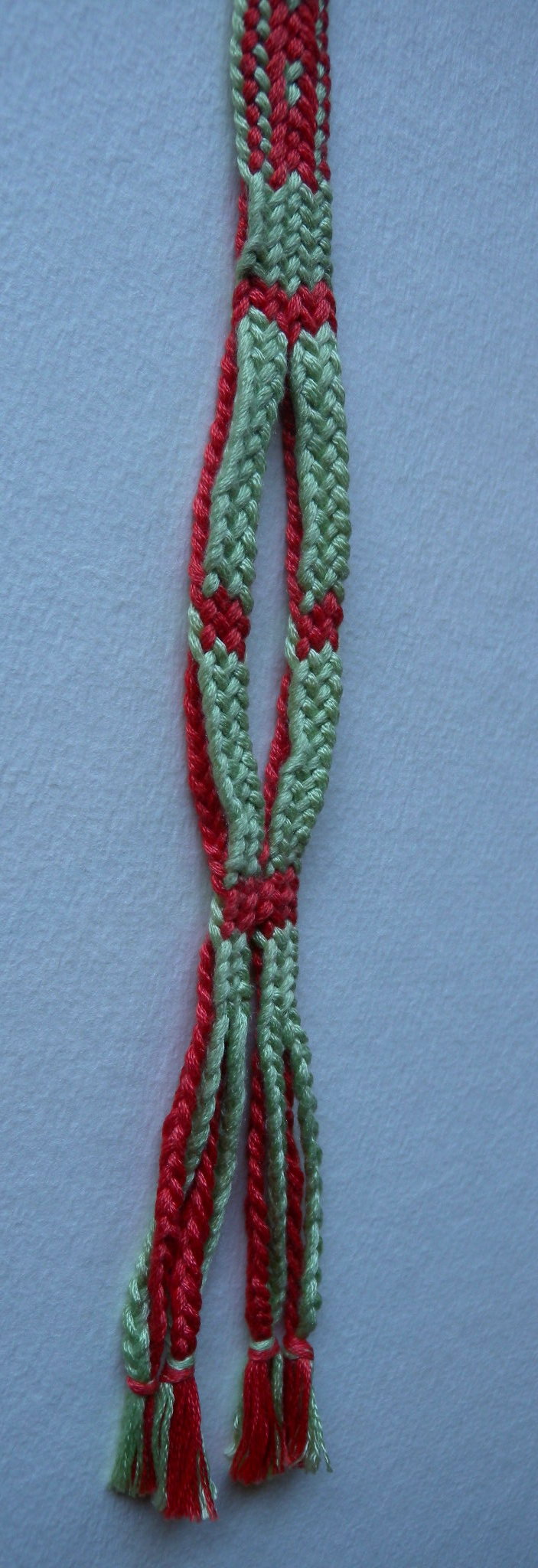
I took a picture of the ending braidlets because the upper part clearly shows the two halves (L and R) of the braid that the 2 workers (or for me, my left and right hands**) would be braiding. The lowest green section—where the two halves join up again—is where the 2 braiders would again be exchanging their adjacent index-finger loops after each cycle to link their 2 braids into one. With my single-braider method, it’s the uppermost d-finger loop on each hand that gets exchanged.
This is the reverse side, to show the opposite color configuration on the other side of the double-weave. If you click on the images to enlarge them, you’ll see the threads coming through where the two colors switch surfaces. It’s the same thing as when you braid a 5 or 7-loop square braid, but without turning (crossing/ reversing) any of the loops when taking them. You get a divided double-weave braid. If you are using bicolor loops, when you turn over the bicolor loops on your fingers so the green shanks are on top, the green comes to the top surface of the braid (and links the two surfaces together at that point). This is essentially how the letters get formed as well. They are in reverse colors on the other side of the braid. Of course they “read” backward there, so there’s only one good side to the braid.
Update: Instructions [now with video] for the braiding method for the very interesting 7-loop braid that is the basis of this letterbraid are here. To make a letterbraid you would also need a braiding partner, and Joy Boutrup’s publication* in order to follow the charts for the individual letters. That post also has a text description of how I hold all 14 loops to braid it solo. I later posted a video tutorial for my solo method for braiding a different letterbraid – the 10-loop Nun’s Book letterbraid.
* European Loop Braiding: Investigations and Results–Part II Instructions for Letter Braids in 17th Century Manuscripts by Noémi Speiser and Joy Boutrup
[this is a separate publication from Part I. Available from BraidersHand]
**Actually, where the braid splits like this into two parts, I put one hand’s loops down on a holder and braid the two separate halves separately–then I pick up and hold all the loops together again for braiding the joined part.
© 2011–2015 Ingrid Crickmore
See full copyright restrictions and permissions at the bottom of the sidebar (if you are on a small screen device, the ‘sidebar’ may appear somewhere other than at the side of the screen).


 Loop Braiding
Is there any way to purchase European Loop Braiding, Investigations and Results: Instructions for Letter Braids in 17th Century Manuscripts Pt. II? I can’t seem to find it anywhere, and I’m super curious of the books contents…
I guess it’s out of print. I would keep looking now and then, surely a used one will come up sometime? It was privately published, probably not a lot of copies – I think it was published by Jennie Parry. Her website is listed on the Braid Society’s “Tutors” pages (hover on Resources in the top menu), but it seems to be a dead end link, her website seems to be gone. https://thebraidsociety.wildapricot.org/
The authors are Joy Boutrup and Noémi Speiser, maybe you could try to contact them? Kind of a long shot, though. If you’re in the SF Bay area of CA we could meet up and I’d be happy to show you my copy, but I’m not interested in selling it!
PS to my earlier reply – I just realized I should have given you a link to my in-depth review of that publication (here on my website, you can also find it under my About tab in the upper menu). It pretty much tells you what’s in it. The word “Instructions” in the title does not mean that the publication itself is a set of instructions – it isn’t! The publication is a monograph intended for museum curators and textile experts about several 17th C. manuscripts of letterbraid instructions, that up til then were not understood. In the appendix, Joy Boutrup does include her own instructions for braiding each of the braids, but these are very brief and succinct with no pictures – a paragraph of instructions for braiding the physical braid, not for the special turning of loops (following the charts in the appendix) to make the letters show up. How to follow the charts for each letter is sort of described in the main text but you might need to understand some basics about the process already. If you have any trouble with this, contact me here or through my contact page (under my About tab).
The text of the publication is mostly about how Joy Boutrup decoded/ deciphered the old texts, and reverse-engineered the braids to figure out how they were made, and then tried out various ways of doing the braiding moves until she hit on the way that made the charts come out with the right lettershapes in the braid, no easy task!