- This post now also includes instructions for a more advanced kute-uchi (hand-held loop) braid called Genji-Uchi, made using both the moves I teach in the two introductory videos below, and information about several other such braids that a solo braider can make, with a (working!) link to the LMBRIC page where I learned them.
- See my post on the Kute-Uchi workshop I took at Braids 2012 for more about Kute-uchi braids made using these two moves.
- Another interesting hand-held loop braiding tradition was used in pre-Incan Andean cultures to create the amazing “mummy braids” – see photos of hand-held loop braiding with over 60 loops at the end of that post (not a tutorial).
- Totally off-topic: at the end of the page below, I went on a bit about why I chose wordpress.com, and this particular format/theme for my site.
I recently dashed off two video tutorials on kute-uchi braiding – a Japanese hand-held loop braiding technique that was the predecessor to Kumihimo. This was in answer to a youtube video request from Petr in the Czech Repuplic! He is very interested in both Kute-uchi and Kumihimo braiding – has now acquired plans for a marudai and is building it himself. Sorry for the bad lighting, especially in the second video, I made these at night. (in my defense/ feeble excuse: this isn’t a professional site and I derive no income from it!!!)
Here are the 2 videos, each demoing one basic Kute-uchi move:
The “Inside-Through” move, making a 5-loop square braid:
Below is a video demonstrating the “Outside-Around” move, also making a 5-loop square braid
I tried to hold the loops spaced apart in these videos, just so they would show clearly for the video. I don’t do this in actual practice, especially when braiding with more than five loops. It’s fine to let the loops touch each other, just don’t let them jump over each other and get out of order. I hold them in place with my thumb (and keep my eye on them!)
I used “bare” loops in these videos. Thicker yarn is better for learning – much easier to keep the loops in order. Another option is to use kute (cord handles) to hold the loops, which also makes it easier to keep them in order.
The “inside-through” move is basically identical to V-fell finger-held loop braiding. The “outside-around” move has no equivalent in traditional fingerloop braiding. By themselves, both these pairs of moves just result in a square braid, like the braids in my “Start Here” 5-loop tutorial for finger-held loop braiding. But using them in combination can create a LOT of different braids!
I was informed either by Masako Kinoshita or Makiko Tada (sorry, I can’t remember now!) that historically, Kute-uchi braiders would almost certainly have used fingerloop braiding for simple square braids (or their flat variation), not hand-held loops as in my videos above. But a five-loop square braid is a good introduction for learning this hand-held loop braiding method.
Hand-held loops were used in Japan when a braider was working with more than 7 or 9 loops, and/or when making “4-step” braids – what I call double braids. These are made by combining the two types of braiding moves shown in these videos: first a left and right Outside-Around move as taught in the second video, then a left and right Inside-Through as taught in the first video.
Depending on whether you hold an even or an odd number of loops on each or either of the two hands, (also whether any of the 4 loop transfers are turned), a solo braider can make an astonishing number of different braids using those two pairs of moves. These braids are like fingerloop braided double braids (which traditionally require two braiders), but with hand-held loops a solo braider can braid them with 16 loops or more.
The double-square (what I sometimes call rectangular) double braid, made in this manner with hand-held loops, has the same structure as a fingerloop braided rectangle braid, but it braids on the vertical rather than horizontal axis – like two connected square braids stacked on top of each other, rather than side-by-side. If two side-by-side kute-uchi braiders each make this rectangular braid, and exchange loops to join their braids, they create a quadruple-square braid – massively and intricately square. Likewise, 3 cooperating braiders can create a sextuple-square braid (wider than square – massively and intricately rectangular in shape).
That’s how the impressive Kumihimo temple braids like Saidai-ji and Chuson-ji were originally made. Totally impossible with fingerloops, no matter how many braiders cooperate.
Below I give instructions for one of the 4-step kute-uchi braids, called Genji-Uchi, or Pseudo Genji-Uchi – depending on whether the Inside-Through pair of loop transfers are not turned (Genji-Uchi) or are turned (Pseudo Genji-Uchi). The first pair of transfers (Outside-Around) are turned in both cases. The two braids look identical unless you use bicolor loops.

Genji-uchi and Pseudo-Genji-Uchi braids, made using moves fr. both videos. 16-36 loops. Cotton, linen, wool. I explained the color set-up for the 3rd braid fr. left in an answer to a question in the comment field below this post.
Click here to jump down to the instructions.
When I learned my first Kute-uchi braids, the Outside-Around move of my second video was a big surprise to me. I had never seen anything like it with finger-held loop braiding. The braids above were very novel, too. The structure is like 2 square braids enmeshed through each other. Hard to tell in a flat photo, but the braids are very solid, and round or squarish in shape, with 8 ridges (these are the narrow vertical columns of stacked threads – a regular square braid has 4 ridges).
Then a couple of years later I had another surprise, when I learned the 14th C. European “Sudarium braid,” done with finger-held loop braiding by two co-operating braiders (traditionally), which looks very similar to Genji-uchi!
You can read more about Masako Kinoshita, and her long-running website L-MBRIC which covered worldwide loop braiding history and practice, on my guide to L-MBRIC (also accessable under my ABOUT tab, in my top menu)
Masako Kinoshita coined the Japanese term Kute-Uchi, and to her it referred to Japanese loop braiding, both finger-held as well as hand-held, since both were part of the same tradition. That tradition lasted at least a thousand years before Japanese braiding guilds gradually switched over to using stand-and-bobbin braiding techniques. By the the turn of the 20th C., loop braiding had been completely forgotten in Japan. When Kinoshita started her research, the last practitioner of Kute-Uchi had been gone for almost a century.
Kinoshita investigated historic braid artifacts as well as old Japanese manuscripts. Amazingly, a key document revealed the original method used for braiding the magnificent Japanese royal, samurai, and temple braids: hand-held loops and many cooperating braiders. This was completely counter to the theories of kumihimo historians at the time – they all assumed the ancient braids had been made on marudai (circular braiding stands), even though a marudai big enough for the most complex of those braids would have to be so large that it could not be used by a single braider sitting in one place.
Kinoshita was eventually able to prove to them that it really was hand-held loop braiding techniques that had been used to make the ancient, very intricate braids that are now national treasures in Japanese shrines and museums. Some of the proof came from analyzing certain mistakes in the ancient braids that can only be made when braiding with loops, not with strands worked individually.
Several years ago, I took an introductory Kute-uchi workshop from kumihimo master Makiko Tada, who had learned Kute-uchi from Masako Kinoshita. It was a very exciting workshop, and I made these braids in the group photo above shortly afterward. Unfortunately I haven’t done much since, so I hope I am not leading anyone astray! (If any of my information here or in the videos is incorrect, please let me know.)
We learned many other kute-uchi braids in the workshop, below is a photo of an entirely different type. This is a twined Kute-uchi braid (with very uneven tension!):
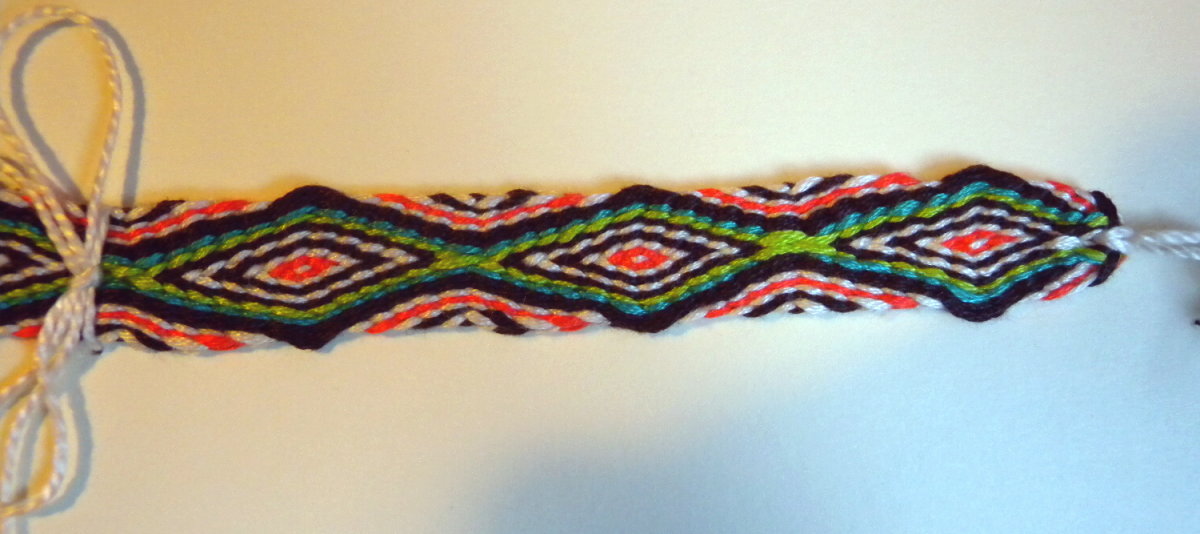
Kute-uchi braid done with twining, karakumi type. (cotton embroidery floss)
This is a very simple version – the amazingly elaborate versions that were done in the past (I think only for royalty) were much wider and more complex, with many rows of nested diamond shapes forming intricate patterns, not just one row of diamonds like my example. This braiding structure is now usually done on a specialized braiding stand called a Karakumidai. Each pair of threads is wound onto two separate bobbins, rather than being held together as a loop, the way they were originally braided. Makiko Tada has made beautiful replicas of some of those complex karakumi-type braids using hand-held loops (as well as on karakumidai), it is one of her many specialties.
“Genji-Uchi” kute-uchi braid – first photo in post:
Here are text instructions for both Genji-Uchi and a very similar and possibly easier braid called Pseudo-genji-uchi. Both braids look very similar to the kumihimo braid Maru-genji-gumi, but according to Masako Kinoshita the kumihimo braid has a different internal structure. They also look like the 14th C. European “Sudarium” fingerloop braid, and I suspect that braid does have the same structure as Pseudo-Genji-Uchi – except that the one known specimen was apparently made from 10 loops, which isn’t a possible number of loops when making it with this Kute-Uchi method.
First learn the braiding moves in both the videos above – Pseudo-genji and Genji-uchi use a combination of both those moves.
Loops:
The total number of loops must be a multiple of 4, (so 8, 12, 16, etc).
4 loops is the minimum required for Pseudo-Genji-uchi – 2 loops on each hand. This will be a very tiny braid, not much like the ones in the photo above, but is a good intro.
8 loops (4 on each hand) is probably the minimum required for true Genji-Uchi – 4 may not hold.
Good color-pattern for learning and practicing: Lengthwise Columns
For this color-pattern, half the loops should be color group X, and half should be color group Y. It’ll be easier to braid if at least one of these two groups is a single color – say, if the X loops are all dark blue. The Y loops could be all one other color, say yellow, or possibly a mix of various colors of loops, say various pastels. Make sure all the colors contrast well with dark blue, or it will be harder to keep the loops in the right order on your hands.
Color setup on the hands:
For this color-pattern, alternate the two groups of colors when loading the loops onto your hands. The loops should be in X, Y, X, Y order on each hand… That is, mirror-image, matching color order on the two hands. For example, Left hand: Blue, pastel, Blue, pastel, (left-to-right), and the same color order in mirror-image on the RIGHT hand, right-to-left.
In the finished braid, the odd-numbered loops (color-group X) will be together in certain columns of the braid, and the ‘evens’ (color-group Y) will be together in the other columns.*
Braiding:
The first 2 loop transfers (left and right) are the outside-around moves from the second video, and the next 2 will be inside-through moves, demoed in the first video. Repeat in this way for the whole braid. If you’ve lined up your colors correctly, you will be making the outside-around moves on all the X colors, and inside-through moves on all the Y colors.
For Pseudo-genji-uchi: TURN all loops when transferring them.
For true Genji-uchi : TURN only the loops that go “outside-around,” and DON’T turn the loops that come “inside-through”.
If the loops get out of order, the color-pattern will probably change. If you notice that they are out of order, put them back into that alternating order: X-color (for Outside-Around), followed by Y-color (Inside-Through), and keep braiding.
Genji-uchi and Pseudo Genji-uchi look very similar. If you use bicolor loops, there will be a minor difference between the braids.
Other color patterns:
Experiment by setting up different starting color arrangements on the hands to find others. For example, in the group braid photo, the first two braids on the left have zigzag encircling rows of colors rather than lengthwise columns of colors.
I think the first braid is of 16 loops.
For a 2-color version use 8 purple and 8 green loops P=purple, G=green:
Left hand loops –> P P P P G G G G G G G G P P P P <– Right hand loops
It should be possible to squeeze a third color into this sequence of zigzag stripes as well, to get, say a purple, green, purple, orange order to the stripes, when seen from certain angles. I think I did this in this first braid by using bicolor loops for the non-purple loops (bicolor loops of one length of green tied to one length of orange).
The second braid from the left seems to have 24 loops, use 12 black and 12 green loops:
B=black, G=green
Left loops –> B B B B B B G G G G G G G G G G G G B B B B B B <– Right loops
(to get the alternation of green and turquoise in the non-black rows, try making each G loop a bicolor loop of green+turquoise)
Other kute-uchi braids:
These same two pairs of braiding moves (Outside-Around, and Inside-Through) can produce several other types of braids, depending on:
A-whether the two hands hold an even or odd number of loops (or one hand even and the other odd). Unlike fingerloop braids, even-odd variations can cause dramatic changes to the form/shape of hand-held kute-uchi braids.
B-which if any loops are turned (on left or right or both/ inside-through loops or outside-around loops, or both)
- A braid with the cross-section of a tall rectangle – like a European double “solid rectangle” braid, but formed vertically – so, unlike fingerloop braids, two side-by-side cooperating braiders can combine two of these into a quadruple square braid.
- Two separate square braids made simultaneously, one above the other (these can be intermittently joined by doing the “solid rectangle” moves of the braid above).
- Four separate, stacked, narrow flat braids made simultaneously (quick way to make an ending fringe for even-number-of-loops braids like Genji-Uchi);
- A hollow braid (not shown on Kinoshita’s Kute-Uchi pages, but possible to make). Like the fingerloop version, this braid can be braided around a core, making it round, otherwise it lies flat.
- An 8-column wide, flat braid (like a fingerloop flat double braid). Known as ‘lacing braid’ because miles of it were braided in past eras to connect Samurai armor plates together for suits of armor. Two side-by-side braiders could theoretically connect two of these flat braids at their ‘open edges’ to make a very large hollow braid, around a core or not.
- A square braid flanked by two separate narrow flat braids – one on either side of the square braid – these can all be of different colors.
- A flat braid with a square-braid ‘ridge’ along its mid-section (visible on one side of the braid – the other side only shows 6 ridges rather than 8), has some interesting color-pattern possibilities.
- Two separate flat braids braided simultaneously, each as wide as the flat version of a square braid.
Masako Kinoshita describes some of these kute-uchi braids on LMBRIC, in her intro illustrated instruction article on Kute-Uchi. The braid possibilities I itemized above would be in her list headed “Four-step Procedures,” because the braids have 4 loop transfers in each full cycle (a cycle or row = one repetition of all the braiding moves). Two-step procedures make simpler braids (square, flat and divided), that have only two loop transfers in each braiding cycle, as shown in each of my two videos. In her list of the various 4-step braids, for the sake of brevity, she labels the Open (not turned) Outside-Around move A, the turned Outside-Around move B, open Inside-Through C, and turned Inside-Through D. Plus O-O for odd-odd (number of loops on each hand), E-E, E-O, etc. There are a few other moves as well, that she mentions at the end, that are used for other braids. (moves E, F, G and Z). The sinuous track-plan diagrams represent the structure of each braid, but aren’t necessary for making them.
Those abbreviations might look confusing when first reading her article, but I find them very helpful when braiding, and also for labeling my sample braids.
Kinoshita’s second L-MBRIC illustrated instruction article on Kute-Uchi covered Kikko braids.
Optional TMI about odd versus even:
The importance of odd vs. even numbers of loops on the hands is because these 4-step kute-uchi braids form in four layers – even though you can only see two layers when you look the loops on your hands. Every OTHER upper strand on your hand (the ‘odds’) gets braided Outside-Around (above the braid), and so corresponds to the first (highest) layer of the braid, whereas the upper strands in between (the ‘evens’) are braided “Inside-Through”, so they interlace on the 2nd layer down! They look ‘together’ on your hand, but are not together in the braid. The corresponding ‘odds’ of the lower strands interlace on the LOWEST (4th) layer, and the ‘evens’ of the lower strands interlace on the second-lowest (3rd) layer. So these braids have some mathematical constraints that don’t apply to two-layer braids.
If you start braiding with an odd number of loops on each hand, once all the loops on one hand get braided, the loops that have come over from the other hand, and which used to be in odd position (highest and lowest layers) are now in EVEN position. So now they’ll be braided Inside-Through instead of Outside-Around, moving them to the middle two layers of the braid. This causes the 1st and 2nd layers to interconnect, and – at the bottom of the loops – the 4th and 3rd layers to interconnect. However, assuming you are not turning the inner transfers (the Inside-Through transfers), the 2nd and 3rd layer will not connect to each other at the center of the braid: this results in two completely separate square braids, one above the other.
However if you start braiding with an EVEN number of loops on each hand, and do the same braiding moves as above (no turns), the even loops remain in even position, and the odds remain in odd position, so no strands migrate to other layers of the braid, and you will actually braid 4 completely separate little flat braids simultaneously, one per layer!
I’d love to get together with other braiders, with an end goal of braiding these as well as Kute-Uchi multi-worker braids. If you are interested and live in the San Francisco Bay Area, contact me! My contact form is in the drop-down under the ABOUT tab in my header menu.
* There will be 4 color columns (two each of the two color-groups), but each color column is really made up of 2 adjacent (same-color) columns of slanting threads. However, if you used bicolor loops for this braid, you could use 4 color-groups, arranged so the braid would have eight (narrower) columns of these 4 colors.
About the change in my blog’s format:
My site is part of WordPress.com. That’s a hosting platform with prefab ‘themes’ (blog or website formats) that has been around a long time now, but still seems to work fine. It spares you from doing much if any behind-the-scenes tech-type work, and offers lots of ‘looks’ (those themes), that you can switch between freely. I’m trying this new theme mostly because its upper menu tabs stand out better than the ones in my old theme. I hope the overall change in the blog’s appearance isn’t too jarring!
Update – after two years on that ‘new’ theme, I’ve just switched to yet another one that also has a prominent upper menu. It’s supposed to work better on different sized devices than the previous one did.
The rest of this ramble is in case anyone reading this is toying with the idea of starting a blog or website, and doesn’t feel they have a lot of tech smarts. (I don’t have any advice on using it as a business, though)
The main problem I expected in using a blog as a teaching/ information-based site was that, in a blog format, all the published posts show up on the homepage in chronological order – newest on top. That’s not necessarily good for a sequence of tutorials jumbled together with non-tutorial posts! The oldest tutorials – which likely are the most basic and important – end up further and further down the pile of posts on the home page. That’s why I later added upper menu tabs so readers could find specific tutorials and other information without having to wade a mile down the blog’s homepage. And it turned out that with the right theme/ format I could even pin links to my beginning tutorials up near the top of my homepage, above the most recent posts.
I found out later that a wordpress.com site really can be made to have a traditional website look, with a static homepage (unlike this blog format, in which the home page changes each time I add a post). The home page can have navigation menus to all the content. But by the time I found that out, I’d come to prefer the blog-style anyway. I like that the home page updates and changes when I publish a new post, plus I hear that it helps your SEO – search engines apparently prioritize new content on the home page.
Also, because I thought of this as a blog rather than a website, it was less intimidating to get started. I didn’t feel that all the pieces had to be in place when I launched it, so it was (slightly) less scary to jump in and just start posting. I hadn’t even dared make a video yet at that point, had been procrastinating on that for a year or more! As my posts began to accumulate, I gradually figured out ways to organize them, and finally made the jump into creating video tutorials.
In case you are interested in starting your own blog or website, the main reason I chose WordPress.com rather than WordPress.ORG (part of the same company, but quite different options!) is that WordPress.com basically does everything for you other than type in the content. I didn’t have to understand anything about web design, hosting, html, etc in order to start my site. I understand a lot more about this stuff now, but I learned it gradually. Also I didn’t have to find programs for spam-blocking or protection from being hacked. This is not the case with a WordPress.ORG install – you are totally on your own in finding all that and trusting that it’s any good. With .org, you do get a theme/format for free from WordPress, (you can also get a free one with .com, though you allow WP to place ads on it in that case – I would rather pay a little per year to not have any ads), but then you have to “self-host” or find a hosting platform, and do all the technical work yourself, find security programs on your own etc. (see WordPress’s own more non-committal comparison of their two services: wordpress.com vs wordpress.org) I found out that people who self-host get hacked all the time. I used to read the users’ forums for WP.com, and there were always a few WP.org (self-hosted) blog-owners who mistakenly came there with their problems before getting redirected to the .org forums. They were the only ones who complained about getting hacked. WordPress.com users do sometimes gripe about updates and changes (myself included!) but never that evildoers hacked their site and corrupted everything and locked them out.
To get started, all I needed to know how to do was to read simple directions in the WordPress support pages, and ask questions on the users’ forum if I ran into trouble. Everything seemed to work and look good right from the start – all I had to do was type in some content, and upload the photos. Yes, that seemed sorta hard to a non-techno person like me, but it was all explained in the little WordPress user tutorials in the Support pages. You do have to look at those to get started, so there is a learning curve at first, but it is a much easier curve, with a lot more protection than self-hosting somewhere with a WordPress.org blog template would be. Plus, if you decide you want to go that route later on, you are free to export your content, stats and followers to a self-hosted site at any point.
With wordpress.com I suppose you have less ability to tinker with your site, but you get one that is already functional, looks good, with great spam control and stats monitoring, and almost zero chances of being hacked, which is not the case if you self-host. I really didn’t want to spend a lot of time designing my site (even if I had the know-how!) There is already so much to choose between with the multitude of themes available that I didn’t feel like a carbon copy of any other sites. I could alter the look of my site simply by uploading my own header image, picking between various color options within each theme, etc.
And, according to people who understand this stuff much better than I do, the WordPress.com platform has good built-in SEO (search engine optimization) magic that starts your blog off with much better visibility in online searches than a self-hosted wordpress.org (or other) install. That said, it still took several months before this site started to appear anywhere near the top 10 pages in a google search for loop braiding – be patient and keep posting, even if it seems at first that you are posting into a void! Apparently it would have taken even longer if I had self-hosted on Go-Daddy or wherever.
Anyway, I’m hoping this new theme/format will be easier to read and navigate. If it doesn’t work out, I may try yet another one – so if everything looks different again the next time you visit, now you’ll know why!
last updated Feb 22, 2026
© 2011–2026 Ingrid Crickmore
See full copyright restrictions and permissions at the bottom of the sidebar (if you are on a small screen device, the ‘sidebar’ may appear somewhere other than at the side of the screen).


 Loop Braiding
Wheres the tutorial for the arrow braid?
Hi ame,
Do you mean the third braid from the left in the group photo?
Sorry, but I didn’t make separate tutorials for all the color patterns I show in that picture.
All the braids in that photo are Genji-uchi or Pseudo-genji-uchi braids, all made with the same braiding moves, just with different numbers of loops, and different color set-ups.
First learn the braiding moves in the two videos at the beginning.
Then learn the 8-loop Pseudo-Genji-Uchi braid from the text-only tutorial above (holding four loops on each hand). After that, you would be able to learn that “arrow” pattern braid.
I just checked my old notes for that particular braid, here’s what they say:
It’s a Pseudo-Genji-Uchi braid (this means that EVERY loop is turned when transferring it to the other hand).
This particular example had 16 loops (8 on each hand). I used embroidery floss, but any smooth strong yarn or thread would work.
All loops are bicolor.
8 loops have one red shank and one black shank.
8 loops have one white shank and one black shank.
(my own threads were actually dark pink, very dark brown, and off-white, but they look red, black and white in this photo)
Start with loops arranged like this:
LEFT Hand, loops in left-to-right order:
4 red/black loops with red shanks uppermost, then 4 white/black loops with white shanks uppermost.
RIGHT Hand loops should be the mirror-image of the left loops in color arrangement (so arrange them right-to-left), EXCEPT that on the right hand, all the loops should have their BLACK shanks uppermost, with their red or white shank lowest.
The braiding moves are the same as I described above in the text-only tutorial. (since this is a Pseudo-Genji-Uchi braid, you must turn the loops every time, you don’t take half of them without a turn as in true Genji-Uchi):
1. take Left hand’s leftmost loop AROUND the other left loops to end up as Right hand’s leftmost loop (and turn the loop while transferring it).
2. Do the same thing except in mirror-image to the Right hand’s rightmost loop. (another AROUND move, with a turn)
3. take Left hand’s leftmost loop THROUGH the other left loops to end up as Right hand’s leftmost loop (turn the loop while transferring it).
4. Do the same thing in mirror-image to the Right hand’s rightmost loop. (another THROUGH move, with a turn).
If you don’t turn each loop when transferring it, the color pattern will be completely different. After 8 repetitions of the above braiding moves, the colors should all be back in the same order on the hands as they started. If they never come back to that order, a mistake has been made in the braiding procedure.
Good luck, please let me know if anything isn’t clear.
–Ingrid
hi im konica.awesome blog! your work is very inspirational,i just loved it..well i’ll b trying some of your works too.feel free to explore me at http://scrapsmania.wordpress.com and do share me your views.i want to see more of your creativity so im hitting ‘follow’.
Hi konica, thanks for following!
Hi
Ingrid merry christmas and happy new year 2012.
I wish you Only the best and I congratulation your workshop.You are great teacher
Petr your Kute-uchi student
Hi Petr, Thank you! I wish you the best, too. Merry christmas and happy braiding in 2012!