I have been rediscovering the treasure that is Masako Kinoshita’s old website L-MBRIC – Loop-Manipulation Braiding Research and Information Center. Beater-stands that allow a solo loop braider to make extra-long braids are just one of many fascinating historical references that she (and her contributors) documented in that trove of articles that she published as an annual online journal for over ten years.
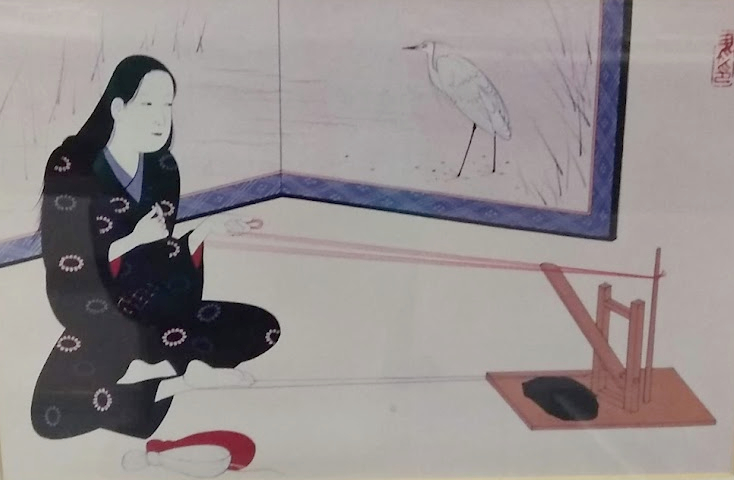
Here’s the link to L-MBRIC issue 6 – a working link, by the way! It goes to the new LMBRIC site, which has 6 of the 13 issues with full functionality, and the rest as black-and-white scans of a hard-copy.*1 Scroll down to the second article to see three very interesting images of historic beating stands for loop braiding – from Japan, Egypt, and Bulgaria. (images will enlarge if you click on them). If you’re interested in other L-MBRIC issues I’ve recently updated my website’s index and guide to L-MBRIC – all the links in it now work(!) Articles are summarized, and two links given for each issue – one to the issue on the new website, and one to the archived original issue. (The index lives under the ‘ABOUT’ tab in my header menu.)
I’ve never tried making either of the two types of beater stands shown in Masako Kinoshita’s article, but about 15 years ago I corresponded with Masako, and she told me she had a foot-operated beater stand made for her. She said it worked, but that it was hard or maybe impossible to ‘unbraid’ when using such long loops – the beater doesn’t help with unbraiding, only braiding. Unbraiding is how you undo a braid to go back and fix a mistake. I unbraid a lot, so that kind of put me off of the idea of beater stands at the time, I figured I would stick with my low-tech tricks for making longer braids (see my post Longer Loop Braids).
But now that I’m thinking about it again, a beater stand might be a great thing to have, especially for making long and fairly simple braids! A mistake in a square braid barely shows, anyway, at least not most of them – and if the color pattern gets ‘off’ you can either ease back into it, or decide that you like the new color pattern even better.
Two different types of beaters are shown in that L-M BRIC article. One has a foot-operated mechanism to beat the fell (base) of the braid – like the beater above. The 2nd type is less complicated – it has a fixed, unmoving beater-post. The braider brings the loops forward (toward him or herself) to push the fell of the braid up against the stationary beater post to tighten. What’s not shown is that you would then need to raise the loops above the beater post to do the next braiding move, and then lower the fell back down behind the post again for the tightening move. So with the stationary-beater type of stand, the loops are moved up and down around the beater post. Whereas with the foot-operated beater, the beater moves up and down into the braid, while the loops stay fairly level.
The beater-stands shown in the LMBRIC article are larger and sturdier-looking than the tiny one in Beth’s photograph above, especially the Bulgarian stand. They’re also taller in back, so the growing braid can hang down the back with a weight attached to steady it and keep it taut. Maybe this smaller stand was intended for braids only up to about twice as long as one can braid comfortably without a beater, and the others were meant for braids of several yards/ meters long? The small stand almost looks too lightweight to withstand the pull of braiding, but it does have a rock or a bag of sand on it to weigh it down.
Masako Kinoshita mentions in the article that Japanese illustrations of foot-operated stands omit a feature that she considered crucial – how the braid can be moved forward (or do I mean back?) so that the fell (a.k.a. the point of braiding) stays in the same position relative to the beater-sword even as the braid grows.*2 Details of how the foot-operated mechanism works were also often omitted from illustrations, probably because the braiding guilds considered those details to be proprietary guild secrets that they didn’t want other guilds or individuals to ‘steal’.
However Masako and her builder were able to come up with solutions to these two questions, so I’m sure others can too. The other type of beater has no moving parts, and might work just as well. I’m not sure I would like a string tied to my toe to do the beating, anyway, though there are probably other options for operating a foot-mechanism!
I’ve added a section on beater stands to my old post on how to make extra-long loop braids. I don’t know why I never added it before now. Maybe I didn’t take beater-stands seriously enough. Masako Kinoshita certainly did – and the illustrations of them she found show that others did, too. Has anyone out there ever made or tried one? If you do, please let me know how you like it!
*1.
Unfortunately, L-MBRIC Issues 7-13 hadn’t transferred over to the new site by the time its old domain lapsed. Thank goodness for the Internet Archive, though! All the original issues can be accessed there, in full color with functional links. My guide and index to L-MBRIC has links (now all working!) to the issues in both locations, plus a synopsis of the topics in each issue. That’s why I’ve been browsing L-MBRIC a lot lately – I’ve been updating my guide’s old broken links to the lapsed L-MBRIC site. You can also find my L-MBRIC guide listed under the ABOUT tab in my menu bar on any page of this site.
The new LMBRIC website’s black-and-white scans of issues 7-13 are handy if you just want some quick info from them. However all the images are dark and blurry – the archived issues are much better.
L-MBRIC is a treasure, but it was always so hard to navigate that it was like a locked and buried treasure! It had no index of articles until the 13th issue came out with a rather weak one hidden in the back. I created my own index to LMBRIC so I would have some way of knowing what was inside each of the issues. My index gives a summary of the articles in each issue, so you can see what’s there and pick which one(s) you want to dive into.
Unfortunately I haven’t been able to go over my whole website and update all my broken links to the former LMBRIC. Still on the list! In the meantime the broken links can actually be used if you copy them and paste them into the Internet Archive’s search engine (the “Wayback Machine“) to find the archived copy.
*2
When I look at the image above, I wonder if a moving sword-type beater might be functional for a range of several inches of braid. Then when the braid has grown past that point, the braider could just stop, set the loops down on a holder temporarily, and retie the start of the braid (at the attachment point on the tall post in back) so that the fell/ point of braiding moves back a few inches, and then pick up the loops and keep braiding. Would that be too much fussy readjusting? I like to put my loops down now and then to take a break from braiding, anyway, so if I only needed to retie every 5 inches or so that would be fine with me.


 Loop Braiding
Pingback: Mugor di lingură – Connecting dots
I just had a thought: what about something like a drum kit’s bass drum beater? It has a foot press to operate it.
Thanks! that’s an amazing idea! My brother-in-law is a drummer, I’ll get him to show me his foot mechanism. Maybe a foot pedal would give you more control than pulling a string. That’s why I was getting interested in the stationary beaters like the Egyptian and Bulgarian illustrations – for those the braider directly pulls the loops against a stationary rod to tighten, seems like you would have a lot more control that way.
I built a beater stand several years ago, but only used it once.
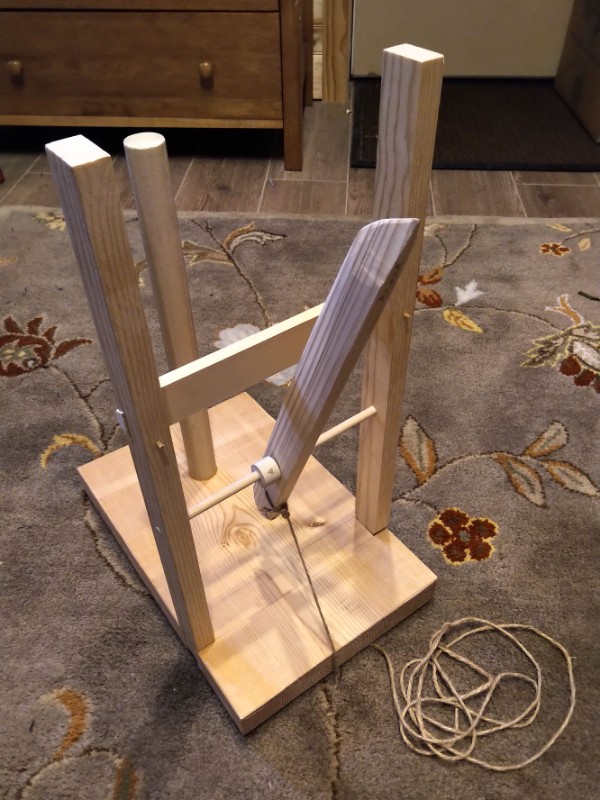
I was not completely happy with the braid it produced, but there may be multiple factors at work.
A friend suggested not “sharpening” the edge of the beater, figuring that a wider beater would spread the strands farther.
Regarding the movement of the fell, I did not find a way to do that without placing the loops on a holder and hiking the leader up on the braid to move the fell back towards the post. Since you need a leader to put the fell closer to the beater when you start, it is ready and waiting.
Hi Elliot, first thank you for making your hard copy of L-MBRIC freely available!
And for this great feedback on beater stands! The one you made is beautiful. I thought too of what your friend said – in the images of the Egyptian and Bulgarian stationary beater stands, those beater-posts don’t look sharp-edged. But maybe it’s more a question of a moving beater not allowing much control? With your beater, is it possible to keep the beater up in the fell for a moment, providing resistance, and then pull the loops against it, or does it only give a whack at the fell and then drop down?
How did you sit and operate the mechanism? Did you actually tie it to your toe like the pictures I’ve seen?! Sorry for so many questions!
It’s possible to keep the beater up against the fell, but you don’t have very much leverage. The beating is mostly from the momentum of the beater. Trying to pull the fell against the beater is likely to produce a multiplied tug on the trigger string.
I tried using the ashiuchidai while floor-seated, but pulling on the string with my toe used my foot muscles in a direction to which they are not accustomed. I do most of my marudai and takadai braiding while standing, so I set the ashiuchidai on a coffee table and tied the string around one leg at the knee. It’s a lot easier to tug with the whole leg than with the foot alone.
I feel like the stands that do not have an integrated post may be easier to use for long braids. As the fell moves closer to the braider, the braider can pull a little harder on the trigger string and the stand will scoot a little closer. I do a lot of traveling with braiding equipment, so I can’t always be sure I will have access to an immovable post and smooth floor.
I agree about a solid post, I always want a solid attachment point for braiding from. It’s just a fantasy at this point, but I’m leaning toward the stationary type of beater stand with no moving parts. Not for traveling though!